
Millions of people wake up every morning and reach for their glasses before they can clearly see across the room. For many, the question of whether LASIK surgery could eliminate that routine has lingered for years, held back by uncertainty about the procedure and a noisy internet full of both exaggerated promises and alarming stories.
This guide cuts through both. By the time you finish reading, you’ll know whether you’re likely a candidate for LASIK surgery, what the procedure actually involves, what recovery genuinely looks like, and what the risk numbers mean in practice.
You’ll also have a clear framework for choosing a surgeon and facility you can trust.
One thing worth saying upfront: where you have this procedure done matters as much as the procedure itself. Specialty eye hospitals such as Sankara Netra Chikitsalaya in Andhra Pradesh, with over 40 years of ophthalmic surgical experience, approach candidacy evaluation and surgical planning very differently from general multi-specialty clinics.
How LASIK Surgery Works: The Cornea Reshaping Process
Step-by-Step: What Happens During the Procedure
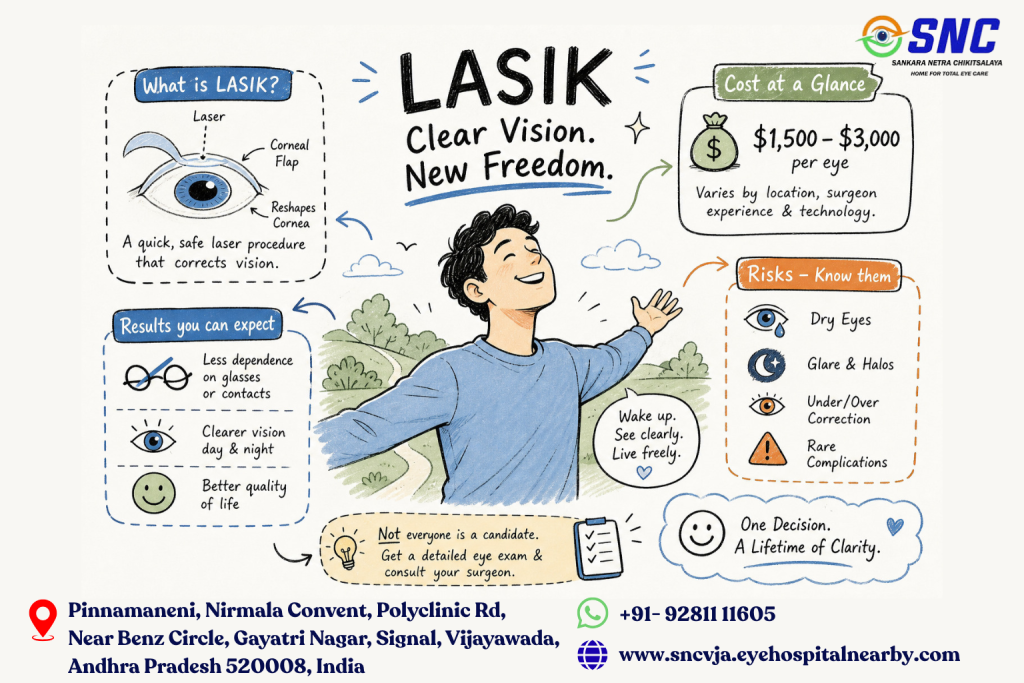
Laser-Assisted In Situ Keratomileusis (LASIK) works by permanently reshaping the cornea so that light focuses correctly on the retina.
The surgery is divided into two distinct laser steps:
- A thin hinged flap is created in the outer corneal tissue.
- The flap is gently folded back.
- An excimer laser removes microscopic amounts of tissue from the underlying cornea.
- The corneal shape is adjusted according to a customized treatment plan.
- The flap is repositioned and naturally adheres without stitches.
The laser treatment itself takes only a few minutes per eye, although the complete procedure-day visit is considerably longer.
The correction targets refractive errors including:
- Myopia (Nearsightedness)
- Hyperopia (Farsightedness)
- Astigmatism
Tissue removal is measured in micrometers, which makes accurate pre-operative mapping critical for achieving precise outcomes.
Bladeless LASIK vs Traditional LASIK
Traditional LASIK used a mechanical microkeratome blade to create the corneal flap.
Modern bladeless LASIK uses a femtosecond laser instead, creating a more precise and consistent flap with lower complication rates.
Additional technologies such as wavefront-guided and topography-guided LASIK provide personalized treatment by mapping the eye’s unique optical characteristics.
Who Qualifies for LASIK Surgery and Who Doesn’t
The Core Eligibility Checklist
Most reputable refractive surgery programs follow similar baseline requirements.
- Age: At least 18 years old.
- Prescription Stability: Stable prescription for at least one year.
- Corneal Thickness: Adequate corneal thickness for safe treatment.
- Tear Production: Healthy tear film and ocular surface.
- Eye Health: No active eye disease or infection.
Meeting these criteria does not automatically qualify a patient, but they form the foundation of candidacy evaluation.
Conditions That Usually Rule Out LASIK
Several conditions may disqualify a patient from LASIK surgery:
- Keratoconus
- Abnormal corneal topography
- Significant glaucoma
- Corneal scarring
- Active eye infections
- Severe dry eye disease
- Uncontrolled diabetes
- Autoimmune disorders
- Use of immunosuppressive medications
- Pregnancy and breastfeeding-related hormonal fluctuations
Not qualifying for LASIK does not mean running out of options. Alternative procedures such as PRK and SMILE may still provide excellent visual outcomes.
What Your Pre-Surgery Evaluation Actually Covers
Diagnostic Tests That Determine Your Candidacy
A comprehensive LASIK evaluation includes several advanced diagnostic tests.
- Corneal Topography
- Pachymetry (Corneal Thickness Measurement)
- Pupil Size Assessment
- Wavefront Aberrometry
- Comprehensive Refraction Testing
- Tear Film Evaluation
Contact lens wearers are typically asked to discontinue lens use for several days before testing because lenses can temporarily alter corneal shape.
What a Skilled Surgical Team Is Looking For
The evaluation process goes far beyond basic eligibility screening.
Experienced refractive surgeons look for:
- Early keratoconus
- Corneal irregularities
- Dry eye severity
- Complex astigmatism
- Prescription instability
- Higher-order optical aberrations
The data collected determines whether LASIK, PRK, SMILE, or another vision correction option is the most appropriate recommendation.
LASIK Surgery Recovery: Timeline and What to Realistically Expect
The First 48 Hours and the First Two Weeks
Most patients experience noticeable vision improvement within 24 hours.
Common early symptoms include:
- Mild discomfort
- Light sensitivity
- Watery eyes
- Temporary vision fluctuations
Most patients return to:
- Desk work within 2–3 days
- Screen use within 2–3 days
- Normal daily activities shortly thereafter
Protective eye shields are commonly worn during sleep for the first week.
Dry Eye, Halos, and When Symptoms Typically Resolve
Dry eye remains the most common LASIK side effect.
Patients may also notice:
- Halos around lights
- Night glare
- Temporary light sensitivity
- Fluctuating vision
Most of these symptoms improve significantly within three to six months as the corneal nerves heal and the ocular surface stabilizes.
Full visual stabilization usually occurs within four to eight weeks, although some patients require additional time.
Real Results and the Risk Numbers Worth Knowing
What the Outcome Data Actually Shows
LASIK consistently demonstrates high levels of patient satisfaction and visual success.
- More than 99% achieve 20/40 vision or better.
- Approximately 90% achieve 20/20 vision or better.
- Patient satisfaction rates are around 96%.
- A small percentage may require enhancement procedures.
These outcomes make LASIK one of the most successful elective procedures in modern medicine.
Rare but Real Risks You Should Understand
Although serious complications are uncommon, patients should understand the potential risks.
- Corneal flap complications
- Corneal ectasia
- Persistent dry eye symptoms
- Night vision disturbances
- Undercorrection or overcorrection
Permanent vision loss from LASIK is extremely rare.
The best protection against complications is careful patient selection and a thorough pre-operative evaluation.
Comparing LASIK, PRK, and SMILE
When PRK or SMILE May Be a Better Fit
Each refractive surgery technique offers unique advantages.
PRK
- Suitable for thinner corneas.
- No corneal flap.
- Preferred for high-impact athletes.
- Longer recovery period.
SMILE
- Minimally invasive.
- No flap creation.
- Reduced dry-eye symptoms.
- Ideal for many myopia patients.
LASIK
- Fastest recovery.
- Most widely available.
- Excellent visual outcomes.
All three procedures provide similar long-term results when matched appropriately to patient anatomy.
How Cost and Candidacy Compare
LASIK generally offers the fastest recovery.
PRK may be slightly less expensive in some centers.
SMILE often commands a premium due to newer technology.
A quality refractive surgery program presents all suitable options rather than recommending the same procedure to every patient.
LASIK Surgery Costs in 2026
What Laser Vision Correction Costs
In the United States, LASIK surgery generally costs between $2,200 and $2,700 per eye, with wider national ranges depending on technology and surgeon experience.
In India, LASIK typically ranges between ₹20,000 and ₹60,000 per eye depending on the procedure type and technology used.
Pricing may include:
- Pre-operative evaluation
- Surgical procedure
- Medications
- Follow-up appointments
Transparent bundled pricing is usually preferable to fragmented fee structures.
How to Evaluate a Surgeon and Facility
What Separates a Quality Refractive Surgery Program
- Comprehensive multi-test evaluations
- Availability of multiple procedure options
- Modern laser platforms
- Dedicated refractive surgery teams
- Structured post-operative follow-up programs
Eye-exclusive hospitals often provide advantages because their infrastructure is designed entirely around ophthalmic care.
Why Decades of Surgical Experience Matter
Experienced surgeons do more than perform procedures. They make better candidacy decisions and recognize when surgery should not be performed.
Sankara Netra Chikitsalaya has more than four decades of ophthalmic surgical experience and has treated hundreds of thousands of patients across Andhra Pradesh.
That depth of experience contributes significantly to patient safety and long-term outcomes.
Making the Decision and Taking the Next Step
LASIK surgery is one of the most researched and consistently successful elective procedures available today.
For suitable candidates, it provides long-term freedom from glasses and contact lenses with high satisfaction rates and a strong safety profile.
The most important step is not scheduling surgery immediately. It is scheduling a thorough refractive evaluation with an experienced ophthalmologist who can determine whether LASIK, PRK, SMILE, or another option best matches your eyes.
No article can replace that evaluation.
With the right surgeon, proper testing, and realistic expectations, LASIK can be a life-changing procedure for many patients.
If you are considering laser vision correction, the next logical step is a comprehensive consultation with a dedicated refractive surgery team focused entirely on eye care.