
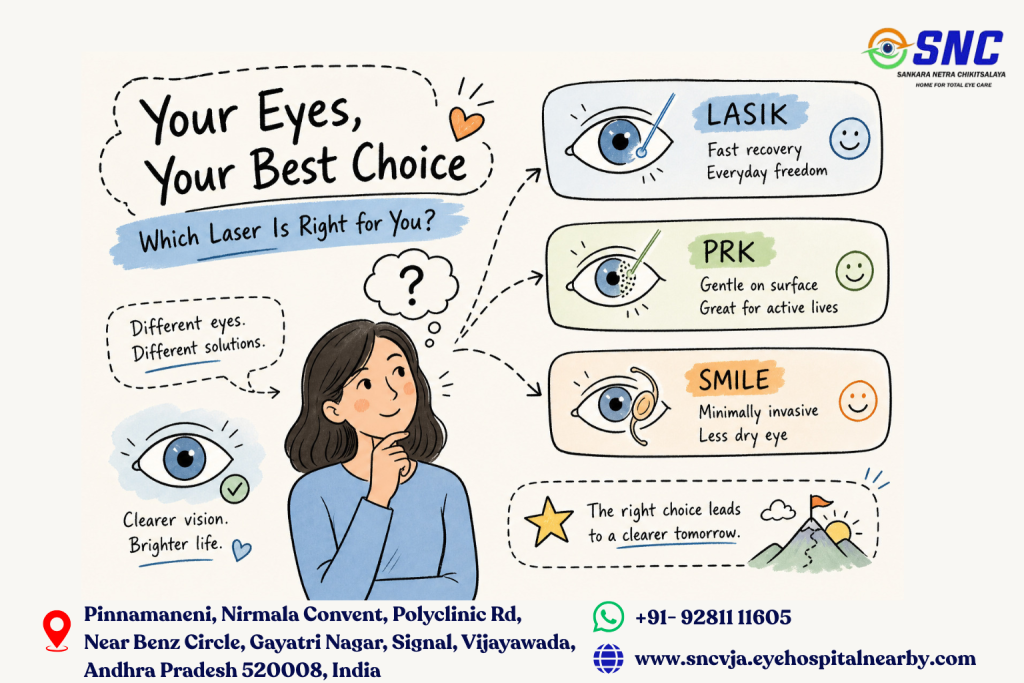
When laser treatment comes up in conversations about blurry vision, diabetic eye disease, glaucoma prevention, or cloudy post-surgery sight, most patients assume these are variations of the same procedure. They aren’t. The laser used to reshape a cornea for sharper vision operates on completely different principles from the one used to seal leaking blood vessels deep inside a diabetic retina.
Confusing them leads to misinformation and can delay the care that actually matches your condition.
This guide covers four distinct ophthalmic laser procedures: LASIK for refractive errors, laser photocoagulation for diabetic retinopathy, laser iridotomy for glaucoma risk, and YAG capsulotomy for post-cataract cloudiness. Each targets a specific condition, a specific part of the eye, and a specific clinical goal.
Sankara Netra Chikitsalaya offers all four procedures within its network across Andhra Pradesh, so patients can access the full spectrum of ophthalmic laser care in one place. By the end of this guide, you’ll know which laser procedure belongs to your situation and what to expect from it.
Why Laser Treatment for Eyes Is Not One-Size-Fits-All
The term “laser eye treatment” groups together procedures that have almost nothing in common except the use of light energy. Some lasers cut and reshape tissue. Some create tiny controlled burns to seal damaged blood vessels. Others punch microscopic openings in the iris to relieve fluid pressure, or use energy pulses to clear a thickened membrane.
The wavelength, intensity, duration, and target tissue differ completely across each procedure.
How Different Lasers Serve Different Purposes in Eye Care
In LASIK, an excimer laser removes microscopic layers of corneal tissue to change how the eye bends incoming light.
In laser photocoagulation, a focused beam heats retinal tissue to seal or destroy leaking blood vessels.
In laser iridotomy, a brief pulse creates a drainage opening in the iris.
In YAG capsulotomy, short energy bursts clear a thickened membrane without any incision at all.
The only shared element across these four procedures is concentrated light energy. Everything else, including the goal, anatomy involved, and recovery, is different.
It is worth noting that ophthalmic lasers are entirely different from cosmetic laser procedures such as CO₂ laser resurfacing or fractional laser skin treatments. This guide focuses exclusively on clinical eye-care laser procedures.
The Four Conditions Driving Most Laser Referrals Today
The conditions that lead most patients toward a laser consultation include:
- Refractive errors such as myopia, hyperopia, and astigmatism.
- Diabetic retinopathy caused by uncontrolled blood sugar.
- Narrow-angle or angle-closure glaucoma risk.
- Posterior capsule opacification after cataract surgery.
Each condition has a specific laser treatment designed for it. Understanding your diagnosis is the first step toward understanding the appropriate treatment.
LASIK: Correcting Your Refractive Error for Good
LASIK is the most widely recognized laser vision correction procedure worldwide. It addresses the root cause of refractive error directly by reshaping the cornea so light focuses properly on the retina.
The result is clearer vision without dependence on glasses or contact lenses.
What Happens During a LASIK Procedure
During LASIK, the surgeon first creates a thin flap in the outer cornea using either a microkeratome blade or a femtosecond laser.
The flap is folded back to expose the underlying corneal tissue.
An excimer laser then removes microscopic amounts of tissue according to your prescription.
The flap is repositioned and naturally adheres without stitches.
The procedure typically takes only a few minutes per eye.
Who Is a Good Candidate for Laser Vision Correction
- Adults with a stable prescription for at least one to two years.
- Patients with adequate corneal thickness.
- Individuals without active eye infections.
- People without significant dry-eye disease.
Patients with keratoconus, extremely thin corneas, or certain autoimmune conditions may not be suitable candidates.
Alternative treatments such as implantable collamer lenses may be recommended instead.
Results and Recovery After LASIK
Most patients notice significantly improved vision within 24 to 48 hours.
Complete visual stabilization generally occurs over several weeks.
Patients should avoid direct water exposure to the eyes, wear protective eyewear outdoors, and attend all follow-up appointments.
Serious complications are uncommon when proper pre-operative evaluation is performed.
Laser Photocoagulation: Protecting Sight in Diabetic Patients
Diabetic retinopathy affects the tiny blood vessels within the retina and remains one of the leading causes of preventable vision loss.
Laser photocoagulation helps stop disease progression before irreversible damage occurs.
How Diabetic Retinopathy Damages the Retina
Chronically elevated blood sugar weakens retinal blood vessels, causing leakage, swelling, and abnormal vessel growth.
These changes can progressively damage central vision.
The condition is particularly dangerous because it often progresses without symptoms.
What Laser Photocoagulation Actually Does
A targeted laser beam creates small, controlled burns on specific retinal areas.
For diabetic macular edema, treatment targets leaking blood vessels.
For proliferative diabetic retinopathy, panretinal photocoagulation (PRP) applies hundreds of laser spots across the peripheral retina to reduce abnormal vessel growth.
The objective is to prevent further vision loss rather than restore vision already lost.
Who Needs This Procedure and When to Act
Patients with moderate to severe diabetic retinopathy are typically candidates for laser photocoagulation.
The best outcomes occur when treatment begins before symptoms develop.
Regular retinal screenings are essential for all diabetic patients.
At Sankara Netra Chikitsalaya, retinal evaluations commonly include fundus photography and Optical Coherence Tomography (OCT).
Laser Iridotomy: Relieving Pressure Before Glaucoma Causes Damage
Laser iridotomy is a preventive treatment designed to stop acute angle-closure glaucoma before it occurs.
Its preventive role makes it one of the most valuable laser procedures in ophthalmology.
The Connection Between Eye Drainage and Glaucoma Risk
The eye continuously produces aqueous humor, a clear fluid that must drain through a narrow angle between the iris and cornea.
In some individuals, this drainage angle is narrow or prone to closure.
When blocked, eye pressure rises rapidly, potentially causing severe pain and permanent vision loss.
Laser iridotomy creates an alternate pathway for fluid movement, reducing this risk.
What the Procedure Involves and What to Expect Afterward
Using numbing eye drops, the ophthalmologist applies a precise laser pulse to the peripheral iris.
This creates a tiny opening that allows fluid to flow more freely.
The procedure usually takes only a few minutes.
Mild light sensitivity and temporary blurring may occur for a day or two.
Most patients return to normal activities quickly.
Who Is Referred for Laser Iridotomy
- Patients with narrow drainage angles.
- Individuals who have experienced angle-closure glaucoma in one eye.
- People with a strong family history of angle-closure glaucoma.
Routine eye examinations are often the only way to detect narrow angles before they become an emergency.
YAG Capsulotomy: Clearing Up Cloudy Vision After Cataract Surgery
Some patients notice blurred vision months or years after cataract surgery and mistakenly believe their cataract has returned.
In reality, the cloudy vision is often caused by posterior capsule opacification (PCO).
YAG capsulotomy is a simple laser procedure that restores clarity.
Why Vision Sometimes Clouds After Cataract Surgery
Following cataract removal, the posterior capsule remains in place to support the intraocular lens.
Residual lens cells can multiply and cloud this membrane over time.
The resulting blur often resembles the symptoms of the original cataract.
How YAG Laser Treatment Restores Clarity
A YAG laser creates a small opening in the center of the cloudy capsule.
This immediately clears the visual pathway and restores sharper vision.
No incisions or injections are required.
Many patients notice improvement within hours.
What to Know Before and After the Procedure
Dilating drops are used before treatment to improve access to the capsule.
Patients should arrange transportation because dilation may temporarily blur vision.
Mild floaters are common for a short period after treatment.
Eye pressure is typically checked before discharge.
Serious complications are rare.
Choosing a Laser Treatment Provider
The success of any laser eye procedure depends not only on technology but also on the expertise of the clinical team and the quality of diagnostic evaluation.
Questions to Ask Before Choosing a Provider
- Does the facility specialize in eye care?
- Is the recommendation based on a complete diagnostic evaluation?
- What laser technology is available?
- Are follow-up appointments included?
- How are complications managed if they occur?
Why a Dedicated Eye Hospital Changes the Outcome
A specialist eye hospital combines advanced diagnostics, laser treatment, surgery, and follow-up care under one roof.
Sankara Netra Chikitsalaya operates across Andhra Pradesh, including Vijayawada, Eluru, Tenali, and Nuzividu.
The network offers all four major ophthalmic laser procedures discussed in this guide.
This continuity of care ensures patients receive diagnosis, treatment, and long-term follow-up from the same experienced team.
Laser Treatment for Eyes Starts With the Right Diagnosis
The correct laser treatment depends entirely on the underlying condition:
- Refractive Error: LASIK
- Diabetic Retinopathy: Laser Photocoagulation
- Narrow-Angle Glaucoma Risk: Laser Iridotomy
- Posterior Capsule Opacification: YAG Capsulotomy
These procedures are not interchangeable, although some patients may require more than one type of laser treatment over time.
Common Questions About Laser Side Effects and Recovery
Recovery varies according to the procedure performed.
- LASIK patients typically return to routine activities within one to two days.
- Laser photocoagulation may cause temporary blurring or mild visual field changes.
- Laser iridotomy usually results in only brief light sensitivity.
- YAG capsulotomy often produces clearer vision within hours.
Across all four procedures, side effects are generally temporary and manageable.
Serious complications are uncommon when treatment is performed after a thorough diagnostic assessment.
The first step is always a comprehensive eye evaluation at a specialist facility capable of determining the exact diagnosis and the most appropriate treatment pathway.
Conclusion
Laser treatment for eye conditions represents one of the most precise and effective areas of modern ophthalmology.
Whether the goal is clearer vision, diabetic retinal protection, glaucoma prevention, or restoring sight after cataract surgery, the key is matching the right laser procedure to the right diagnosis.
At Sankara Netra Chikitsalaya, patients can access a complete range of ophthalmic laser treatments supported by advanced diagnostics and experienced specialists.
The technology is proven, the outcomes are well documented, and the process begins with a thorough eye examination and expert consultation.